China Best Blue Light Therapy Device Manufacturers?

Time:2026-10-27 Author:Amelia
0%

Choosing among China’s best Blue Light Therapy device manufacturers requires more than comparing prices or attractive product photos. The right supplier should demonstrate engineering experience, consistent production, and clear evidence behind its performance claims. Buyers should examine wavelength accuracy, irradiance stability, treatment-area design, heat control, and user safety features. Small details matter. A loose cable or unclear control panel can damage trust quickly.

Established manufacturers often support OEM and private-label projects, but their capabilities can differ sharply. Look for ISO 13485 quality systems, relevant electrical safety testing, traceable component records, and documented quality-control procedures. Regulatory expectations vary by market, so reliable suppliers should provide transparent technical files and realistic compliance guidance. Certifications alone are not enough. Independent verification is still valuable.

Factory audits can reveal practical strengths that brochures hide. Observe assembly benches, calibration equipment, packaging standards, and how staff handle product complaints. Ask for sample units and test whether light output remains stable during repeated sessions. Some suppliers communicate well before payment, then respond slowly after delivery. That risk deserves attention. “Best” is not absolute. It depends on intended users, treatment goals, budget, and target market.

This overview introduces leading Chinese Blue Light Therapy device manufacturers through an evidence-focused lens. It considers product quality, customization, manufacturing capacity, service responsiveness, and long-term reliability. The available information may not answer every question, especially when performance data comes from manufacturers themselves. Careful buyers should verify current certifications, clinical claims, warranty terms, and after-sales support before making a final decision. Expect progress, but keep a healthy level of doubt.
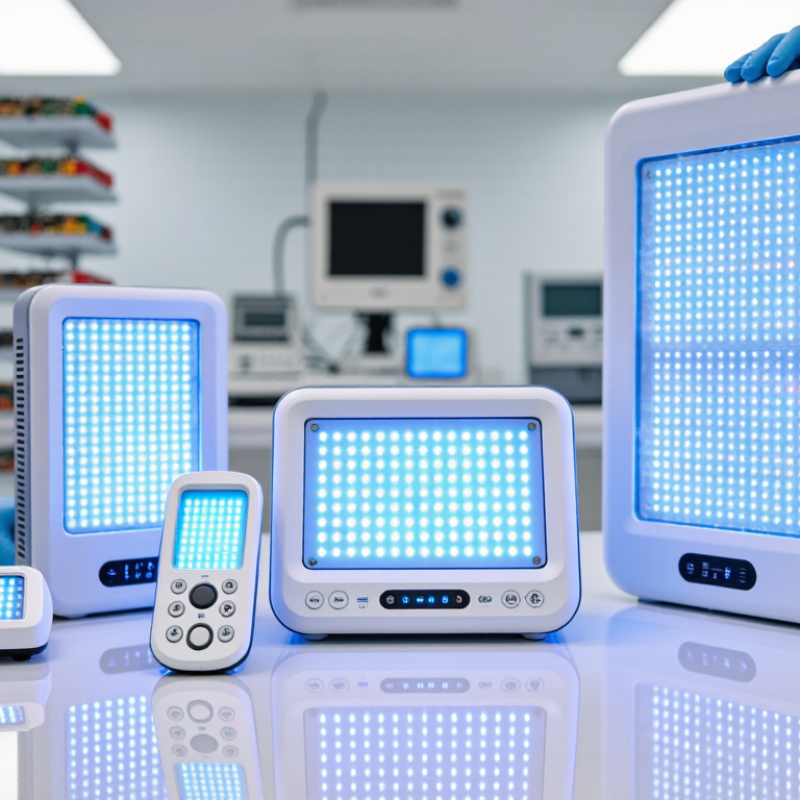
China Best Blue Light Therapy Device Manufacturers?

What Defines a Leading Blue Light Therapy Device Manufacturer in China

A leading blue light therapy device manufacturer in China is defined by evidence, not factory size. Grand View Research estimated the global LED light therapy devices market at approximately USD 1.1 billion in 2023, with continued growth expected through 2030. This expansion increases pressure on manufacturers to prove performance, safety, and consistency.

Experienced manufacturers measure wavelength accuracy, irradiance, and heat during development. A calibrated spectrometer should verify whether a device delivers its stated blue-light range. Thermal cameras can identify uncomfortable hotspots around the treatment surface. Batch testing matters too. One good prototype proves little.

Look for ISO 13485 quality systems and testing aligned with IEC 60601-1 and IEC 62471. These frameworks support electrical safety and photobiological risk assessment. A serious supplier should provide traceable test records, not only attractive samples. It should also explain optical power changes after prolonged use. No shortcuts.

Market research from Fortune Business Insights also indicates rising demand for home-based light therapy equipment, making reliability more important than packaging. A capable Chinese manufacturer should offer clear user instructions, production traceability, and responsive technical support. Clinical claims require careful evidence and honest limits. No factory is flawless. The stronger ones disclose weaknesses, investigate failures, and improve the next production batch.

What Defines a Leading Blue Light Therapy Device Manufacturer in China?

Leading manufacturers are typically evaluated by measurable factors such as clinically relevant wavelength selection, optical output, treatment consistency, product safety, quality systems, and long-term LED reliability.

Reference benchmarks are representative technical and quality indicators used in supplier evaluation, not data from any specific company or brand. Actual specifications should be verified for each device model.

Key Technologies Used in Chinese Blue Light Therapy Devices

China Best Blue Light Therapy Device Manufacturers?

Key Technologies Used in Chinese Blue Light Therapy Devices

Chinese blue light therapy devices increasingly combine narrow-band LEDs, precision drivers, and compact thermal systems. Many models use wavelengths near 415 nanometers, while others include nearby blue or violet ranges. Engineers adjust irradiance, exposure time, and beam distribution for more consistent sessions. Higher power is not automatically better. Excessive intensity may increase discomfort and heat.

Optical design also affects performance. Diffusers help reduce bright spots across the treatment area. Aluminum heat sinks move heat away from the LED board, while temperature sensors monitor surface conditions. Constant-current circuits can limit output changes during extended use. Small details matter. In practical testing, uneven spacing between LEDs sometimes creates visible intensity differences. This issue deserves more attention.

Modern controllers may record treatment duration, regulate pulse settings, and stop operation when contact changes. Some devices use proximity sensors or protective eyewear reminders. Reliable manufacturers should verify wavelength accuracy, irradiance, electrical safety, and photobiological risks through documented laboratory testing. Relevant evaluations may reference IEC 62471 and, where applicable, IEC 60601 requirements. Independent calibration is valuable because displayed numbers can drift from real output. Peer-reviewed evidence should guide intended use, but laboratory performance alone cannot prove every clinical claim.

Major Types of Blue Light Therapy Device Manufacturers

China’s Best Blue Light Therapy Device Manufacturers: Major Types

China’s blue light therapy industry includes several manufacturer types. Clinical equipment producers usually build large LED panels for dermatology clinics and wellness centers. Their systems may offer adjustable irradiance, cooling fans, treatment timers, and replaceable light modules. Buyers should request wavelength testing, electrical safety records, and documented quality controls.

Home-use manufacturers focus on compact masks, handheld tools, and small tabletop units. These products often use lightweight housings and preset treatment programs. Good manufacturers explain dose, distance, session length, and eye protection clearly. Some factories also provide contract manufacturing and private-label services. They can modify casing designs, packaging, software settings, and user manuals. However, customization should not replace independent testing.

Another group specializes in modular LED components and treatment cabins. They may supply panels, controllers, power systems, or complete installations to integrators. Their strength is technical flexibility, but after-sales support can vary. Ask about thermal testing, batch inspection, repair procedures, and production traceability. Factory photographs are useful, but they are not proof of capability. The category is not perfectly neat. A small producer may offer better engineering than a larger exporter, though its documentation may need closer review. During supplier evaluation, practical experience matters: inspect sample build quality, measure light output independently, and compare claims with clinical evidence.

How to Evaluate Chinese Blue Light Therapy Device Suppliers

China’s blue light therapy device market is expanding, but supplier quality remains uneven.

Grand View Research estimated the global LED light therapy market at about USD 1.1 billion in 2023. That growth attracts capable factories and inexperienced assemblers.

Evaluate suppliers through evidence, not attractive catalogs.
Ask for wavelength accuracy, irradiance readings, treatment distance, and thermal test results. A supplier should provide recent reports from an independent laboratory. Check whether testing follows IEC 62471 for photobiological safety and IEC 60601-1 where medical electrical equipment applies. ISO 13485 certification can support quality management, but it does not prove clinical effectiveness.

Request production samples from the same line used for commercial orders.
Measure the device after twenty minutes, when heat and output may change. Inspect LED spacing, cable strain relief, timer accuracy, and eye protection. Ask how rejected units are recorded and corrected. These details reveal more than a showroom visit. Documentation must match the physical device.

Clinical claims deserve extra caution.
A 2023 review in Photodermatology, Photoimmunology & Photomedicine reported that blue-light outcomes vary with wavelength, dose, and treatment schedule. Do not accept “professional results” without test conditions. My checklist is still imperfect. A factory may pass an audit yet fail consistency six months later. Require batch records, calibration schedules, warranty terms, and a small pilot order before scaling.

Manufacturing Standards, Certifications, and Quality Control in China

China’s best blue light therapy device manufacturers should demonstrate controlled processes, not just attractive certificates. ISO Survey 2023 recorded more than 1.26 million ISO 9001 certificates worldwide, showing the system’s broad adoption. Yet ISO 9001 alone does not prove medical-device competence. For therapeutic equipment, ISO 13485 should govern design controls, supplier qualification, risk management, and complaint handling. The factory should also test electrical safety under IEC 60601-1 and photobiological risks under IEC 62471. Claims determine regulatory classification and registration requirements in China.

Quality control must be visible on the production floor. I look for incoming LED inspection, wavelength verification, irradiance mapping, thermal testing, and traceable calibration records. Each batch should retain serial numbers, operator records, test results, and deviation reports. Intertek’s 2023 quality-management research emphasized that supplier failures remain a major source of product risk, making component control essential. A reliable manufacturer should test representative samples after aging, not only before shipment. Small details matter.

A certificate can age.

Some factories still treat final inspection as the main safeguard. That is weak practice. Independent laboratory reports, production-site audits, and corrective-action evidence provide stronger assurance. Even careful systems can miss uneven light distribution or skin-contact heating. Manufacturers should disclose these limitations instead of hiding them behind polished documentation.

China Best Blue Light Therapy Device Manufacturers? – Manufacturing Standards, Certifications, and Quality Control in China

Evaluation Dimension Applicable Standard, Regulation, or Control What a Qualified Manufacturer Should Demonstrate Typical Verification Evidence Quality-Control Focus
Regulatory Classification NMPA medical-device classification based on intended use, risk level, energy output, and claims A documented classification rationale and a regulatory pathway that matches the device's intended medical or cosmetic use Classification documentation, product technical requirements, registration or filing records where applicable Preventing a mismatch between product claims, technical design, labeling, and regulatory status
Quality Management System ISO 13485:2016 or an equivalent medical-device quality-management framework Documented controls for design, purchasing, production, traceability, complaints, corrective actions, and supplier management Valid certificate issued by an accredited certification body, audit reports, controlled procedures Consistent processes, controlled records, nonconformance handling, and continual improvement
Electrical Safety IEC 60601-1 and the applicable Chinese adoption, such as GB 9706.1-2020 where applicable Evidence that the device has been assessed for electrical shock, insulation, leakage current, temperature, mechanical hazards, and essential performance Type-test report, risk-management file, electrical safety test records Insulation integrity, grounding, enclosure safety, power-supply reliability, and abnormal-operation testing
Electromagnetic Compatibility IEC 60601-1-2 and relevant national or market-specific EMC requirements Demonstrated immunity to electromagnetic disturbances and controlled electromagnetic emissions during normal operation EMC test report covering emissions, electrostatic discharge, radiated immunity, and conducted immunity Stable output and safe operation near other electronic equipment
Photobiological Safety IEC 62471 assessment for photobiological hazards from optical radiation Risk assessment of blue-light exposure to the eyes and skin, including limits related to wavelength, irradiance, exposure time, and viewing distance Photobiological safety report, optical radiation measurements, exposure-limit assessment Control of retinal blue-light hazard, unintended exposure, shielding, viewing distance, and treatment duration
Risk Management ISO 14971:2019 or the applicable medical-device risk-management requirements A complete risk file covering optical exposure, overheating, electrical faults, misuse, software faults, cleaning, and foreseeable user errors Hazard analysis, risk-control matrix, benefit-risk evaluation, residual-risk review Risk controls must be verified and reflected in the instructions for use and labeling
Usability Engineering IEC 62366-1 where usability-related risks may affect safe use Usability activities addressing treatment setup, eye protection, dose selection, treatment distance, and alarm recognition Use-related risk analysis, formative evaluation, validation testing, user instructions Reducing errors caused by incorrect positioning, exposure time, intensity, or operating mode
Optical Output Accuracy Product-specific specifications for wavelength, bandwidth, irradiance, treatment area, and dose Measured output should remain within approved tolerances throughout the specified operating life Calibrated spectrometer and optical power-meter records, incoming and final inspection reports Wavelength consistency, LED or light-source uniformity, irradiance stability, and dose repeatability
Thermal Management Design and verification controls for accessible surface temperature and internal heat dissipation Evidence that the device remains within safe temperature limits during normal, extended, and abnormal operation Temperature-mapping results, thermal cut-off tests, airflow or heat-sink verification Prevention of skin burns, premature LED aging, housing deformation, and thermal drift
Timer and Dose Control Validated control of treatment duration and, where applicable, intensity or programmed dose Timer accuracy and automatic shut-off should be verified across operating modes and fault conditions Functional test records, software verification, timer calibration data, alarm tests Accurate dose delivery, protection against overexposure, and reliable restart behavior
Software and Firmware Software lifecycle controls appropriate to the device's software risk Controlled requirements, architecture, verification, cybersecurity considerations, version management, and change control Software validation file, test protocols, release records, checksum or version traceability Preventing unintended changes to treatment parameters, timers, alarms, and user access controls
Material and Biocompatibility Review ISO 10993 assessment when patient-contacting materials are used Materials in contact with skin or mucosal tissue should be identified and assessed for the relevant contact duration Material declarations, supplier certificates, biocompatibility test reports where required Control of skin irritation, sensitization, extractables, and material changes
Incoming Inspection Documented inspection plans for LEDs, optical components, power supplies, plastics, cables, and control boards Critical components should be checked against approved specifications before release to production Incoming inspection records, supplier certificates, lot numbers, sampling plans Component authenticity, optical performance, electrical ratings, and lot-to-lot consistency
Production Process Control Controlled work instructions and validated or verified assembly processes Assembly, soldering, wiring, optical alignment, software loading, and labeling should be performed under controlled conditions Work instructions, operator training records, line-inspection reports, process validation documents Repeatable assembly quality, correct wiring, secure connectors, and accurate product labeling
Final Inspection and Testing Risk-based release criteria defined in the product technical documentation Every finished unit should pass applicable functional, safety, optical, visual, and packaging checks before shipment Final inspection checklist, serial-number traceability, calibration records, release authorization Verification of light output, timer operation, controls, alarms, enclosure condition, and accessories
Reliability Testing Product-specific reliability and environmental test program Testing should reflect expected use, including operating cycles, transportation, storage, vibration, humidity, and power variation where relevant Reliability test reports, accelerated aging data, environmental test records Long-term optical stability, mechanical durability, connector life, and power-supply performance
Calibration and Measurement Traceability Calibration program aligned with ISO 13485 measurement-control requirements Test instruments used for optical, electrical, temperature, and timing measurements should be calibrated at defined intervals Calibration certificates traceable to recognized national or international standards Reliable measurement results and prevention of false pass or fail decisions
Labeling and Instructions Applicable NMPA, Chinese labeling, and target-market labeling requirements Labels and instructions should state intended use, contraindications, warnings, exposure instructions, cleaning, maintenance, and technical parameters Approved artwork, controlled instruction manual, label inspection records, translation review Clear disclosure of wavelength, irradiance, treatment time, eye-protection requirements, and limitations
Traceability and Post-Market Control Complaint handling, adverse-event monitoring, corrective and preventive action, and recall procedures The manufacturer should be able to trace critical components and finished products by lot or serial number Complaint log, CAPA records, recall procedure, distribution records, service reports Fast investigation of field issues and controlled implementation of corrective actions
Environmental Compliance Applicable RoHS, REACH, WEEE, packaging, and target-market environmental requirements Material composition and restricted-substance compliance should be documented for the intended sales markets Supplier declarations, laboratory test reports, material-composition records Control of restricted substances, responsible disposal information, and supply-chain transparency
Certification Verification Independent confirmation of certificate scope, validity, issuing body, and covered product or facility Certificates should apply to the relevant legal manufacturer, manufacturing site, product scope, and current production model Certificate number, validity dates, accreditation details, scope statement, audit status Distinguishing valid, product-relevant certification from generic or expired documentation

FAQS

What types of blue light therapy device manufacturers operate in China?

Clinical equipment makers produce large panels for clinics and wellness centers.

What information should a home-use device manufacturer provide?

Ask for wavelength, light dose, treatment distance, session length, and eye protection guidance.

How can buyers evaluate a supplier beyond its catalog?

Request independent reports for wavelength accuracy, irradiance, electrical safety, and thermal performance.

Why should a buyer test the device after twenty minutes?

Heat may increase during operation.

Which quality standards may matter for these devices?

IEC 60601-1 may apply to medical electrical equipment.

What production details should a reliable factory document?

Records should cover incoming LED checks, wavelength verification, irradiance mapping, and thermal testing.

How should buyers assess clinical performance claims?

Ask for the tested wavelength, dose, distance, schedule, and measured outcomes.

What should a buyer inspect in a production sample?

Check LED spacing, cable strain relief, timer accuracy, housing quality, and eye protection.

Is a factory audit enough before placing a large order?

No. Require batch records, calibration schedules, warranty terms, and corrective-action evidence.

Conclusion

China’s leading Blue Light Therapy device manufacturers are defined by strong research and development capabilities, reliable production capacity, consistent product performance, and a clear understanding of user safety. They commonly develop devices for skincare, wellness, and professional applications, using technologies such as specific blue-light wavelengths, LED arrays, intelligent control systems, adjustable intensity, and thermal management. Manufacturers may specialize in consumer devices, professional equipment, customized OEM/ODM solutions, or integrated medical and aesthetic systems.

When evaluating Chinese suppliers, buyers should review technical documentation, product testing data, manufacturing experience, customization capabilities, communication efficiency, and after-sales support. It is also important to verify whether the factory follows recognized manufacturing standards, maintains traceable quality-control procedures, and holds applicable certifications for its intended markets. A dependable supplier should demonstrate strict material inspection, assembly testing, electrical safety checks, performance verification, and final product inspection. By comparing these factors systematically, buyers can identify manufacturers that offer safe, stable, compliant, and commercially suitable Blue Light Therapy solutions.

Amelia

Amelia

Amelia is a seasoned marketing professional with a wealth of expertise in our company’s core offerings. With an unwavering passion for driving growth and innovation, she plays a pivotal role in shaping our marketing strategies and enhancing brand visibility. A key aspect of her responsibilities......